Co-Founder / Embedded Firmware
2026 - presentConfidential embedded startup
A wearable guidance device: it measures the wearer's position and orientation, and a smartphone turns directions into left and right vibrations. As co-founder, I developed the device's embedded firmware, from GNSS and IMU acquisition to the Bluetooth Low Energy protocol and haptic control. After a first prototype assembled from modules, we integrated the electronics on a PCB. The product and the company stay confidential.
How it works
The device streams position and orientation to a smartphone ten times per second. The phone compares the heading with the bearing to the next waypoint and sends a command back; the device vibrates on the side to turn towards.
Current PCB
The current prototype integrates the electronics on one board: a 3.3 V buck-boost supply from off-board cells, the nRF52840 Bluetooth Low Energy microcontroller, a GNSS receiver with an active antenna, an IMU with on-chip orientation fusion, and one haptic driver per linear resonant actuator.
Firmware and validation
- AcquisitionGNSS NMEA parsing (position, fix, satellites, dilution of precision) and IMU orientation reports at 20 Hz, re-armed after a sensor reset.
- CalibrationA dedicated calibration firmware and PC wizard: gyroscope, six-position accelerometer and magnetometer, with the result stored in the IMU.
- Protocol and BLEA fixed little-endian binary frame with sequence number, timestamps, sample ages, position, attitude and validity flags, published at 10 Hz without drift through a GATT service. Commands come back by write.
- Haptic commandEach command is checked for version and size, then applied to the left and right outputs.
- Diagnostics and testsUSB console with a command trace and a pulse test per actuator; bench firmwares for I2C, GNSS UART and PPS; mock sensor providers. A PC dashboard and a BLE simulator decode the same frame.
On the first prototype, commands sent from a phone drove both actuators end to end on the bench.
Team and situation
Three students and an engineer who has already filed a patent. A first contract proposal was turned down; we are now looking for funding.
Prototype 0
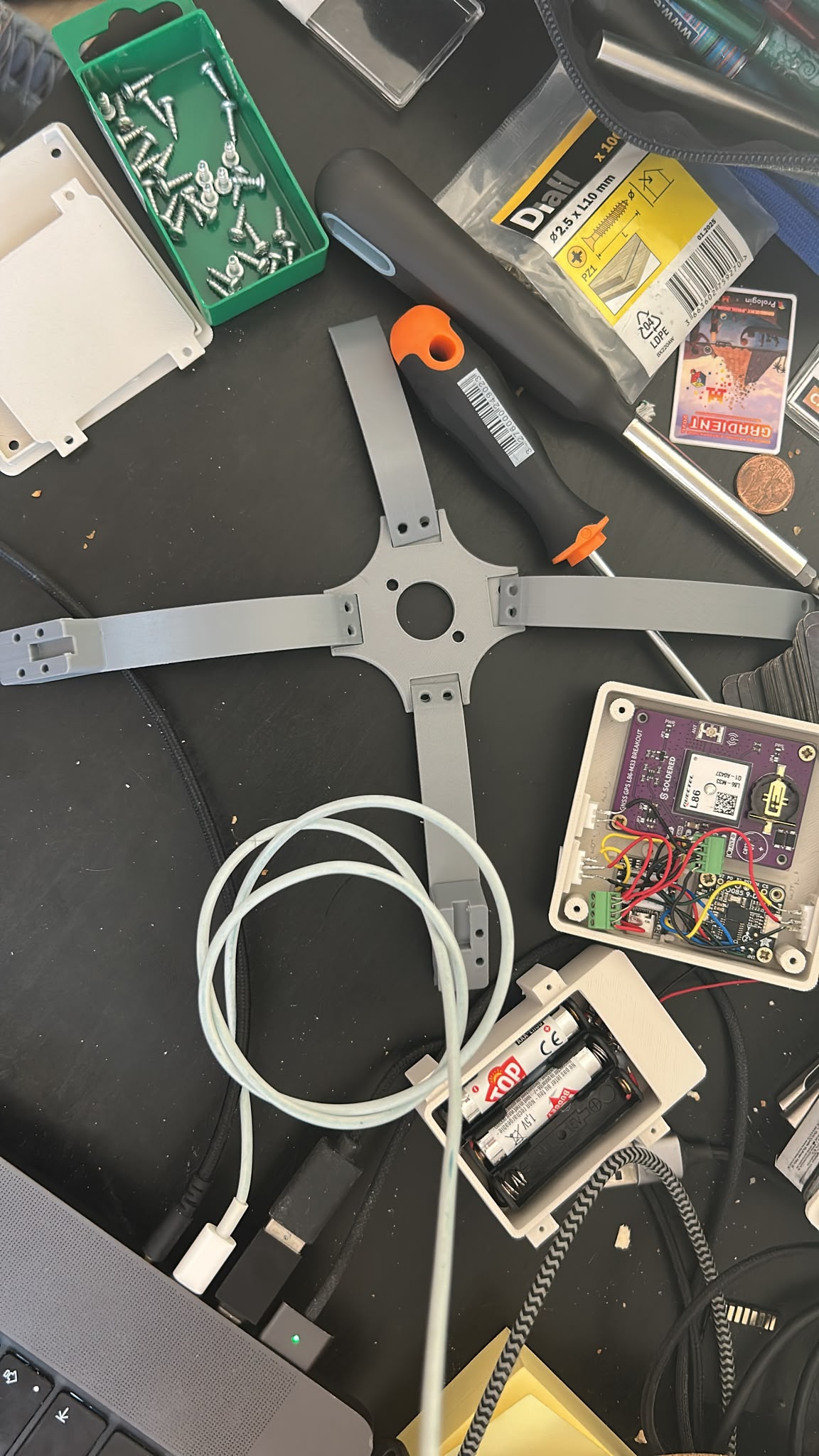
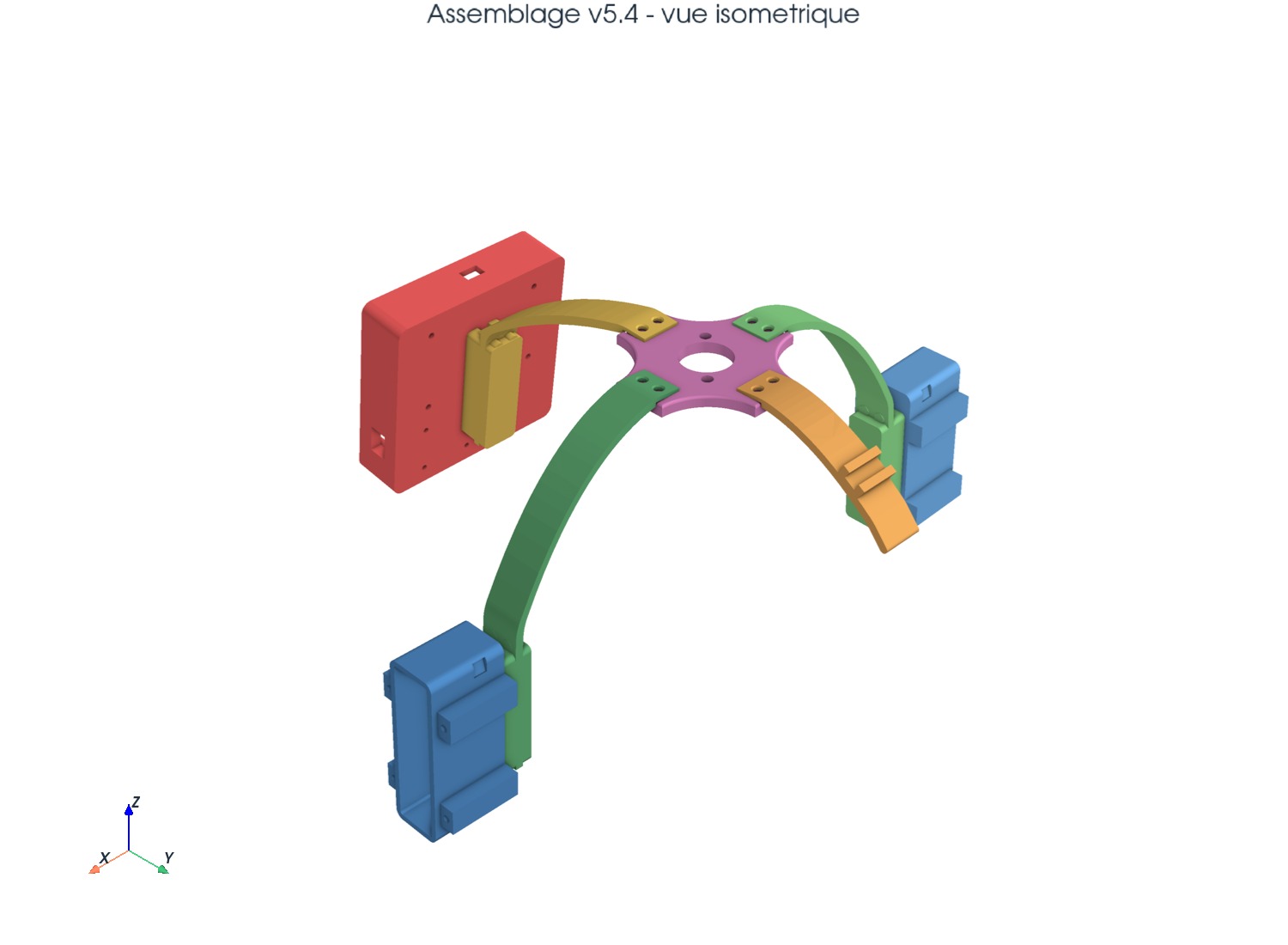
The first prototype assembled modules on a printed frame: a BLE microcontroller board, GNSS and IMU breakouts, and two vibration motors driven directly by PWM. The CAD study below explored the enclosure.